Launch offer — valid today only

📄 Digital book in PDF · read it on your phone or print it

Canada's Advanced Amateur Radio Theory in Drawings Every Calculation in the Same Order

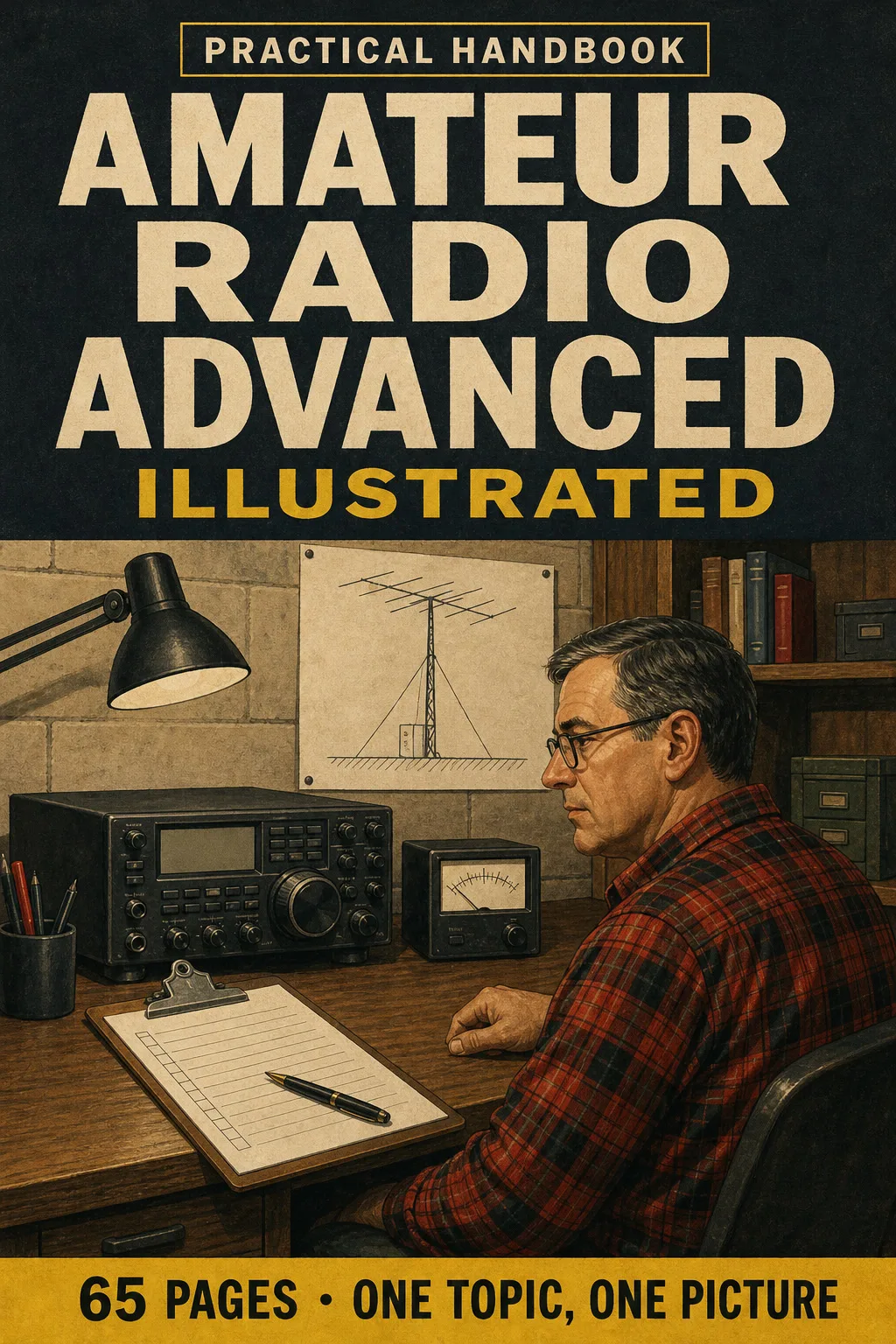
Ohm's law, reactance, resonance, decibels, rectifiers, the SSB transmitter, the superheterodyne, SWR and the Yagi. Every topic has its own page: the drawing first, then what you need to remember. 65 illustrated pages.

START STUDYING THIS WAY

🔒 Secure checkout · PDF by email · 30-day guarantee

Every topic, its own pageEach formula drawn, with the worked steps beside it
65 illustrated pages8 parts, from what the Advanced unlocks to the exam-day checklist
Up-to-date sourcesISED Advanced question bank, RIC-3 and RBR-4, Safety Code 6
PDF by emailFormat

Look Inside the Book

Every page has one big drawing and a box with the formulas and numbers you need to know:

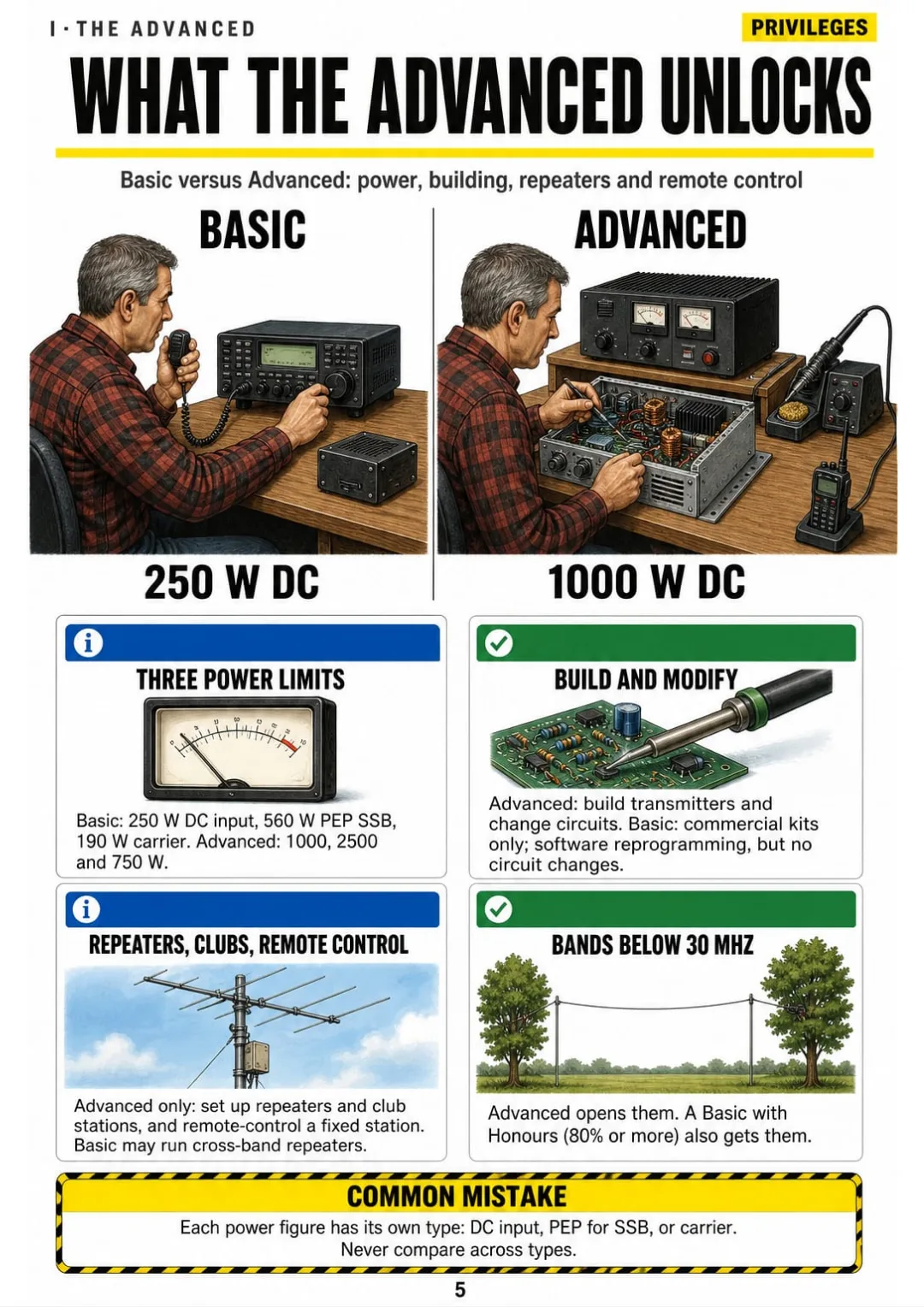
Advanced: 1000 W DC input, 2500 W PEP, plus home-built rigs, repeaters and remote control (RBR-4, RIC-3).
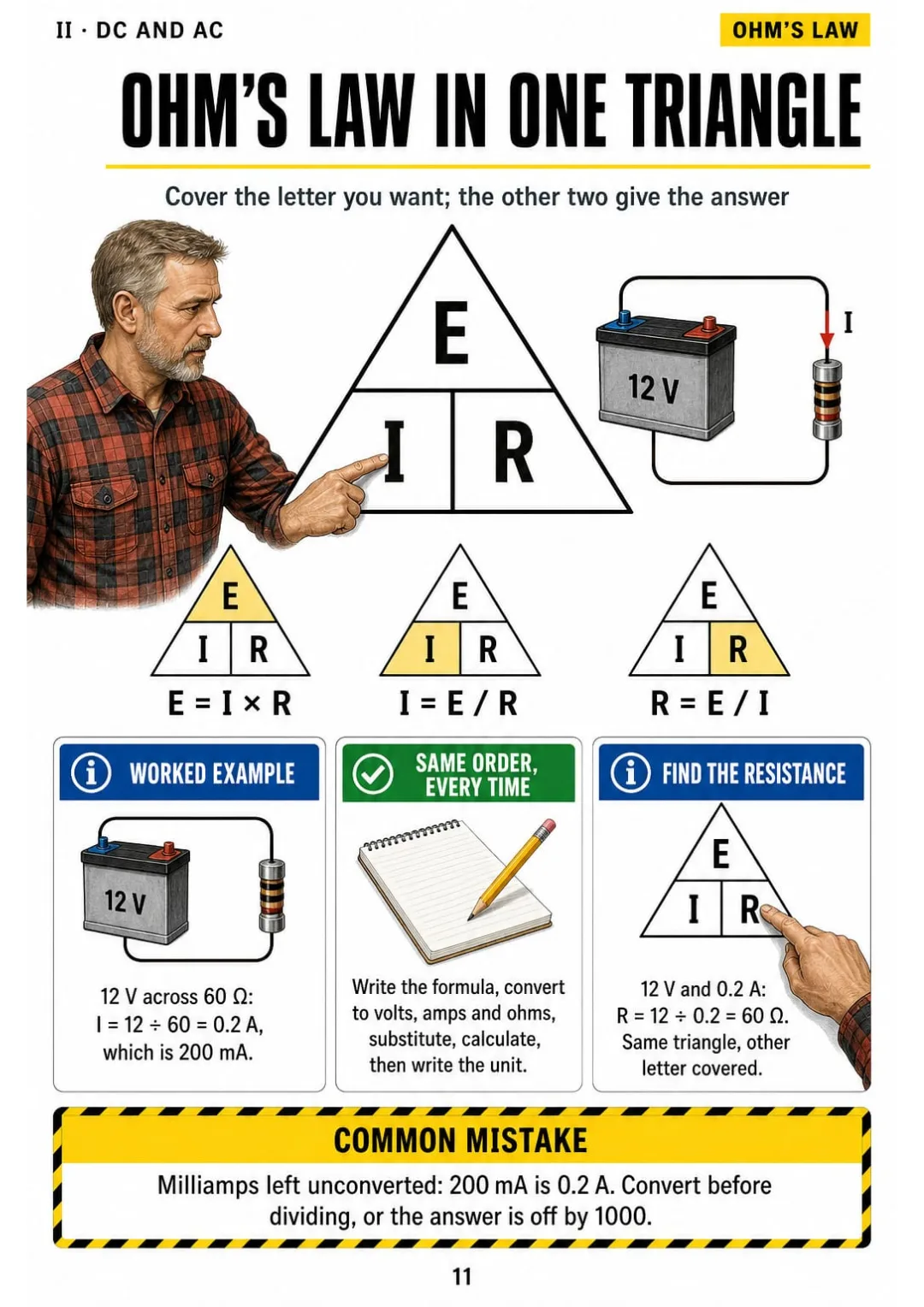
12 V across 60 Ω = 0.2 A (200 mA): one triangle, three formulas.
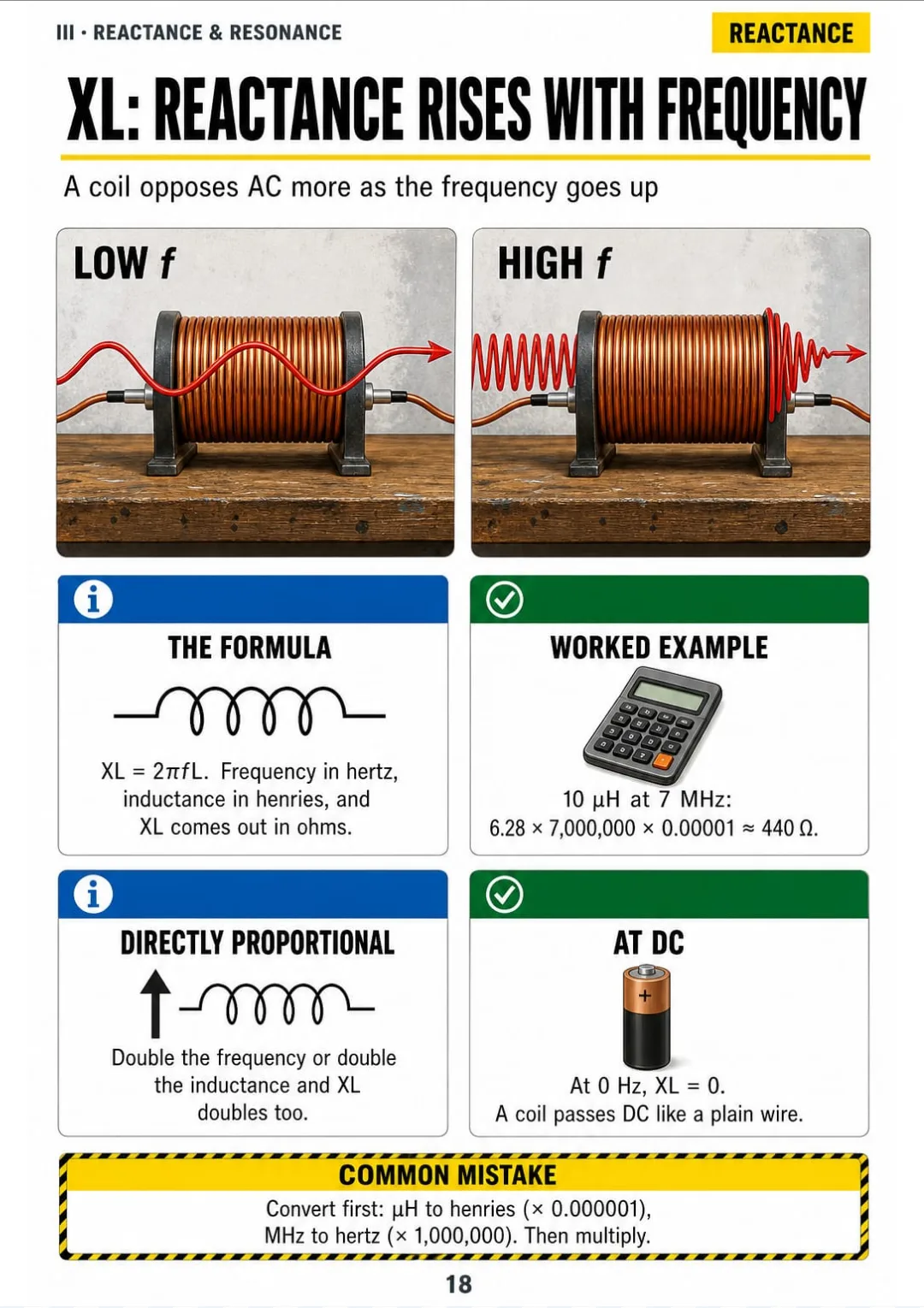
XL = 2πfL: 10 µH at 7 MHz gives about 440 Ω
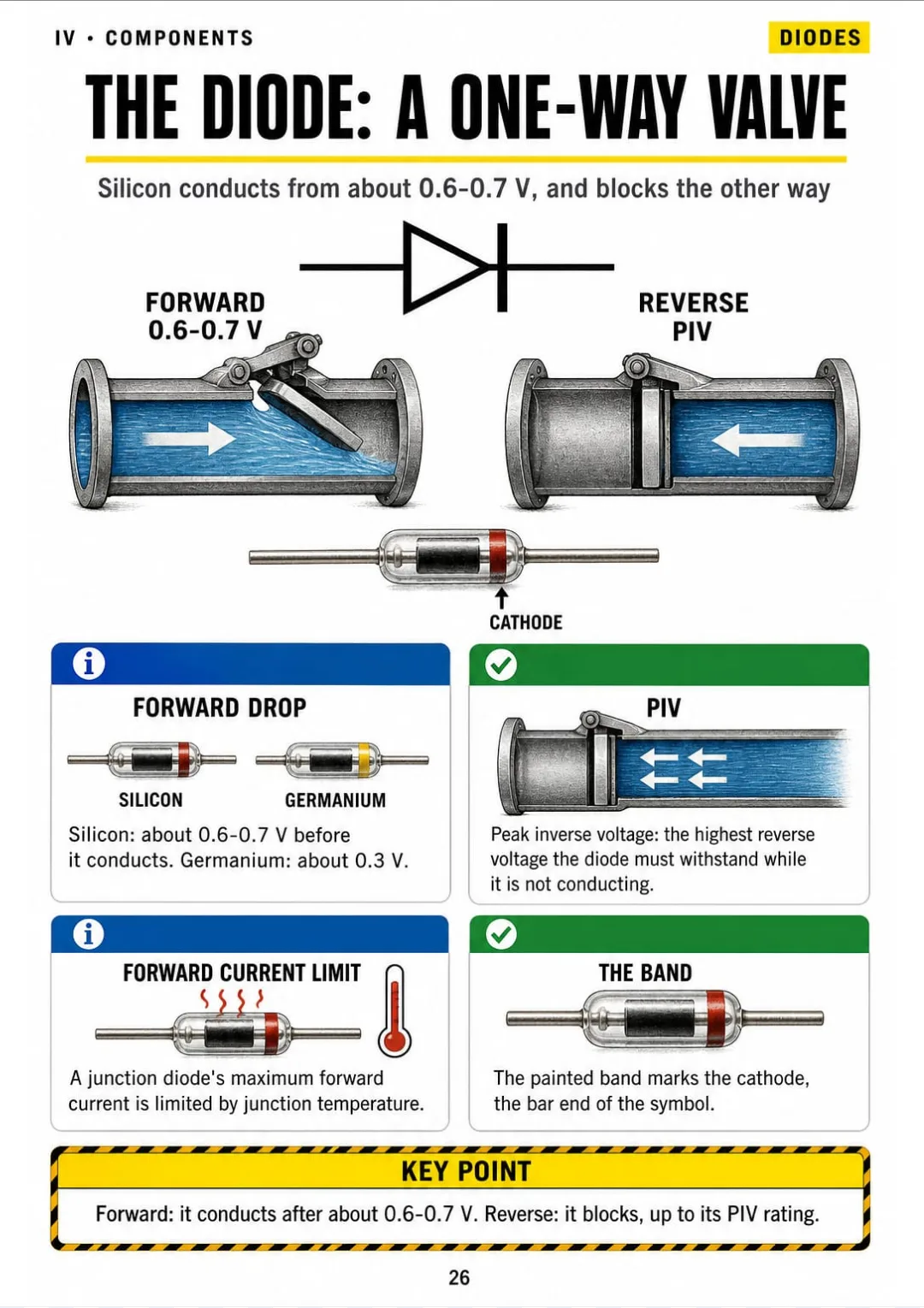
Silicon diode: conducts from about 0.6-0.7 V; PIV is what it withstands in reverse
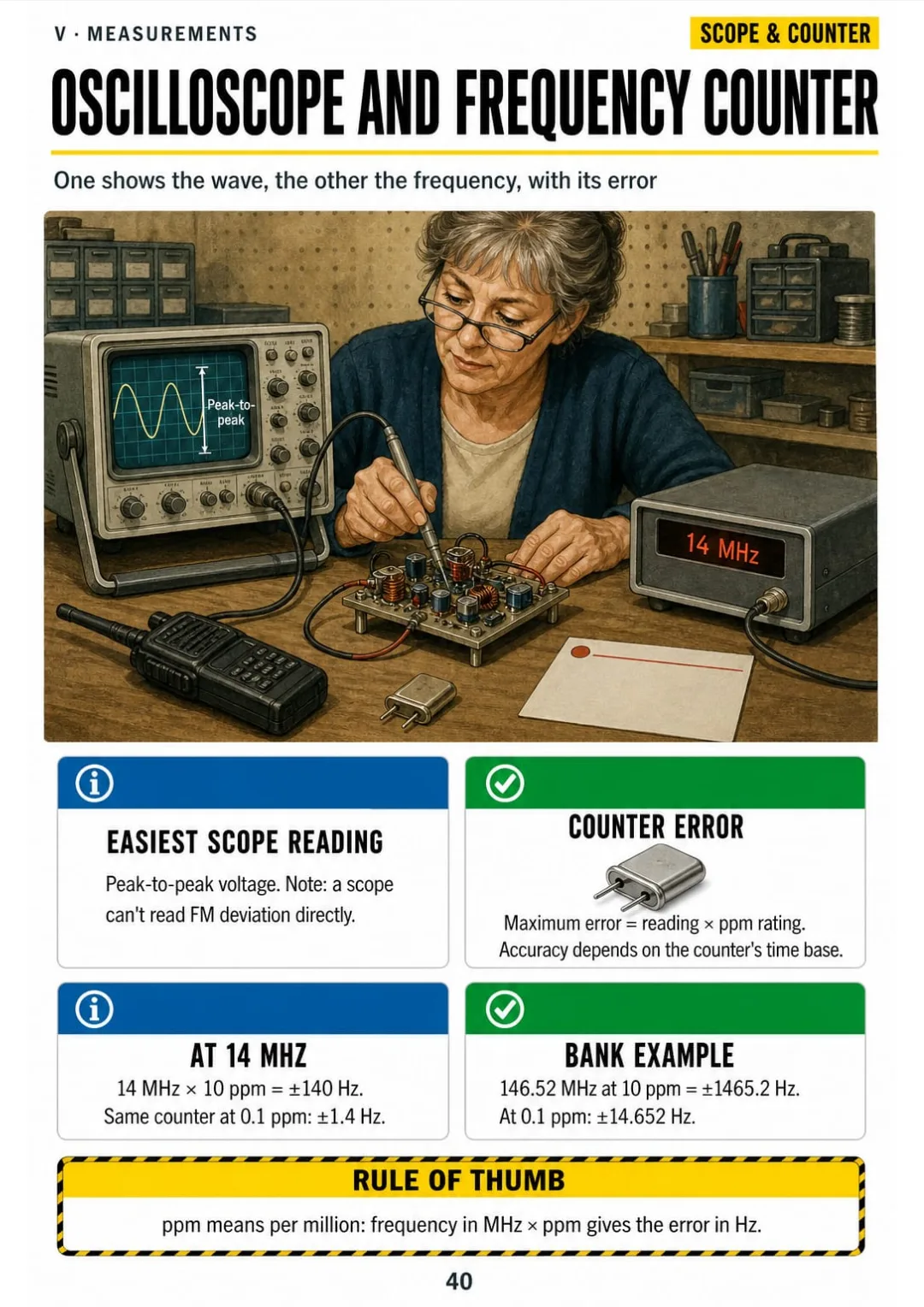
Counter error = reading × ppm · 14 MHz at 10 ppm = ±140 Hz
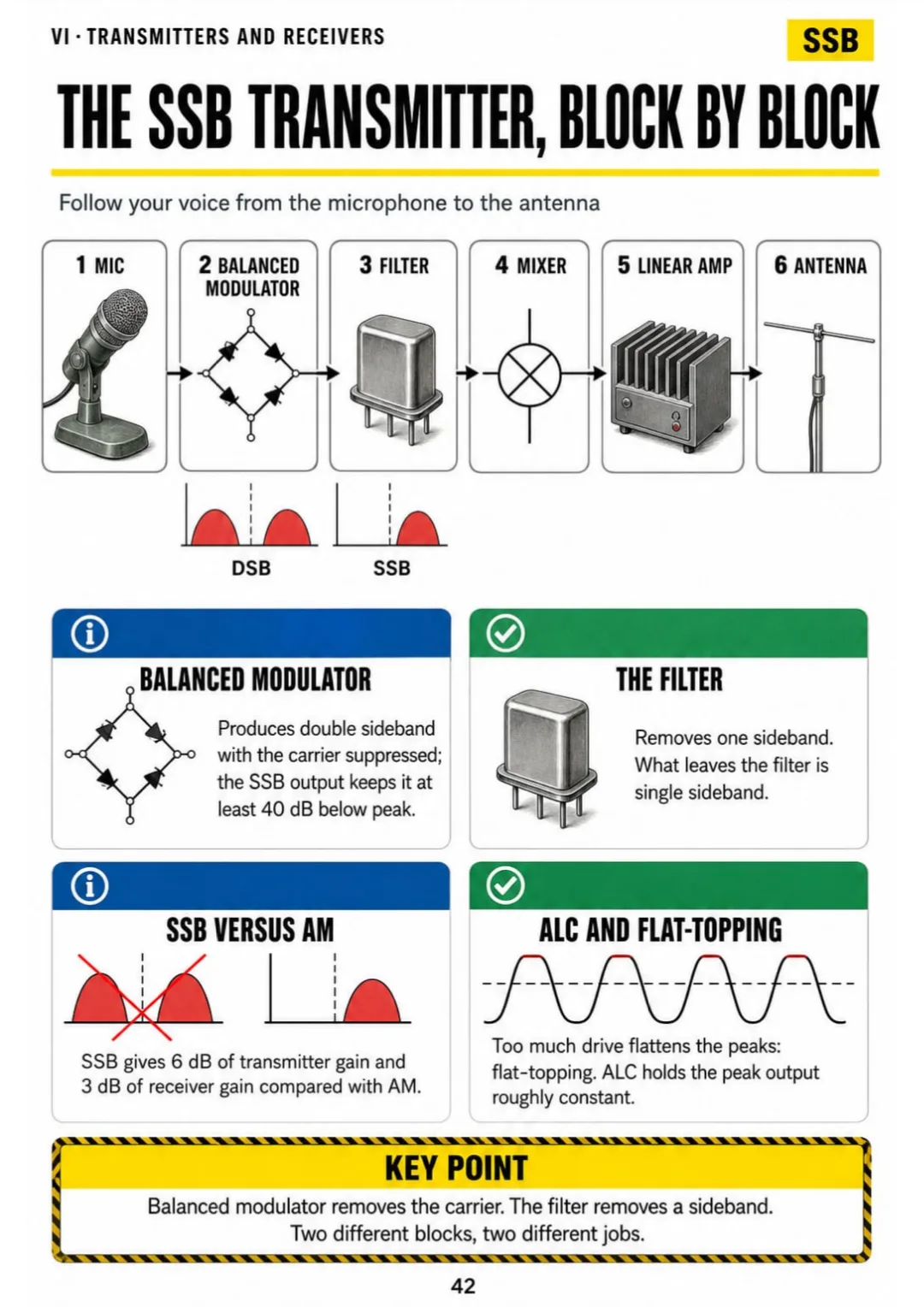
Balanced modulator: carrier suppressed. Filter: one sideband gone. Carrier at least 40 dB below peak.
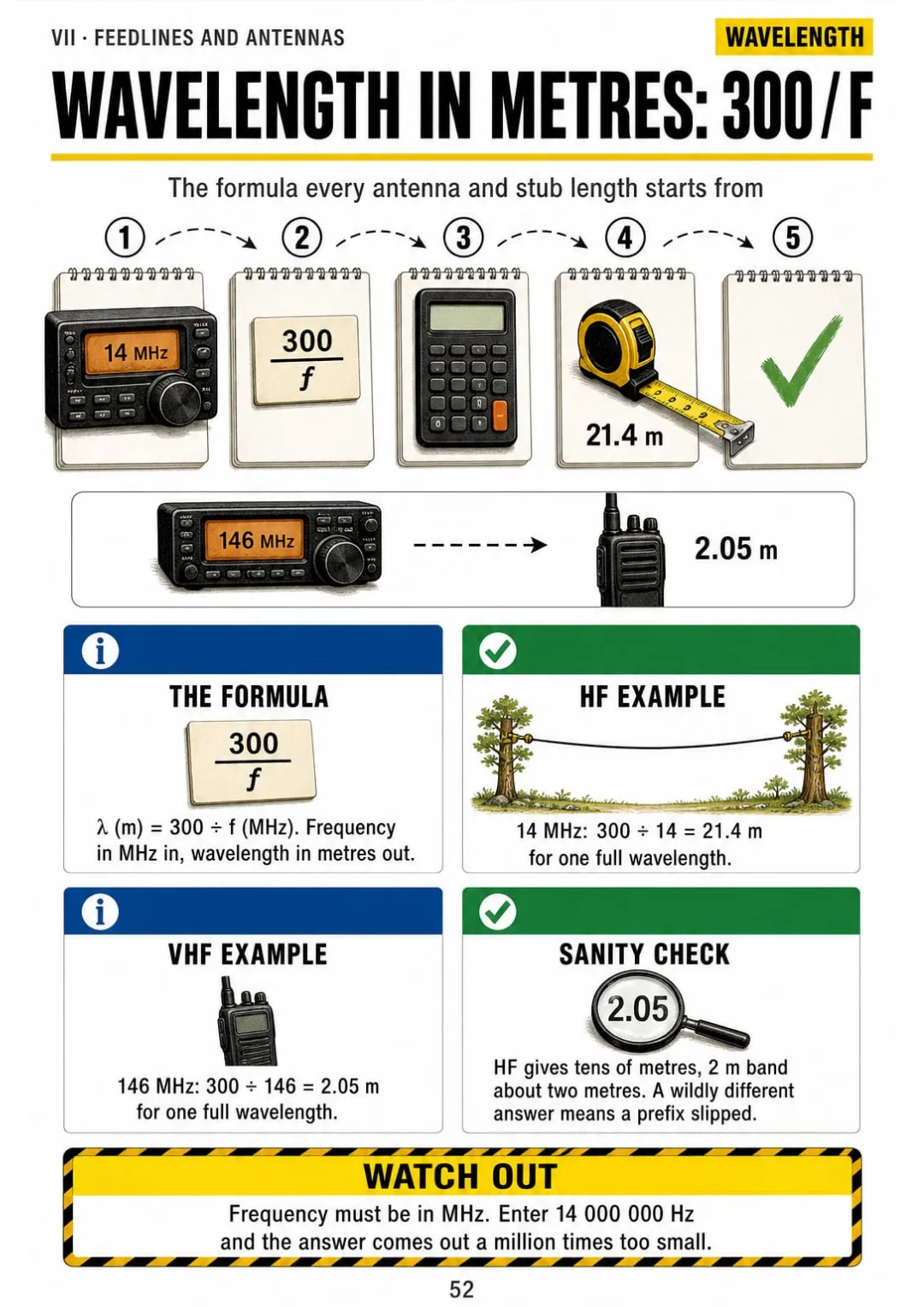
λ = 300 / f: 14 MHz is 21.4 m, 146 MHz is 2.05 m, worked in five steps.
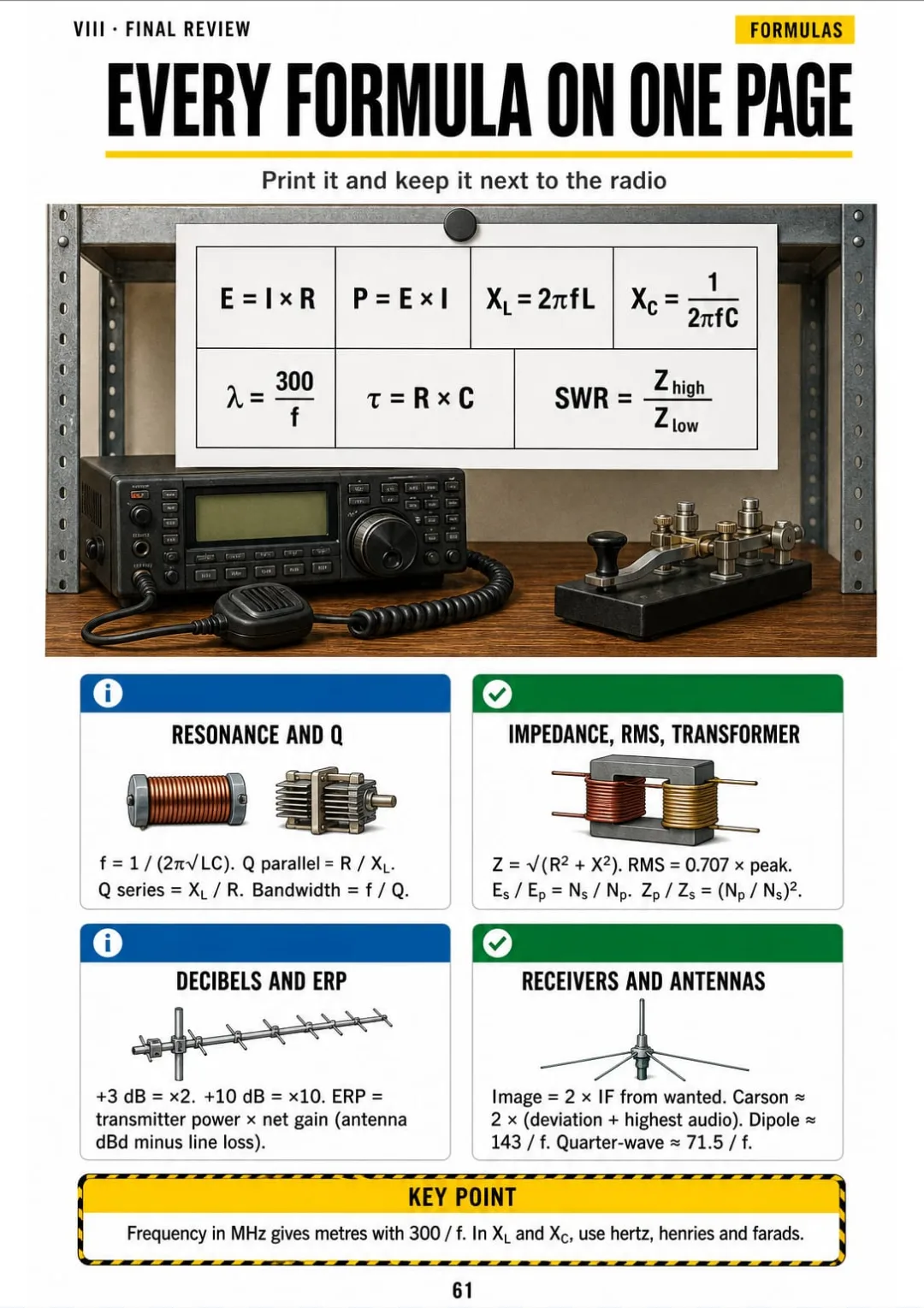
Ohm, XL, XC, resonance, Q, τ, dB, transformer, ERP, image, Carson, SWR and 300 / f on one sheet

Swipe to see more →

These are real pages from the book. The table of contents is the full one: 8 parts and 61 topics.

The Problem Isn't You. It's How It Was Explained to You.

It's ten at night and the practice question reads: 10 µH at 7 MHz, what is the inductive reactance? You remember a letter from the question bank, but these aren't the numbers you memorized.

The manual gives you XL = 2πfL in the middle of a paragraph full of definitions and Greek letters, and never shows why the number climbs when the frequency does. By morning, it's gone.

XL = 2πfL: 10 µH at 7 MHz gives about 440 Ω

In the book, inductive reactance is one page: a coil, a frequency dial and the XL bar growing as you turn it up. Underneath, the formula worked in five steps: 2 × 3.14 × 7,000,000 × 0.00001, about 440 Ω.

Capacitive reactance, resonance, decibels, the image frequency and SWR get the same treatment: one topic, one page, one drawing.

You see why the answer is right, and you work it out with whatever numbers they put in the question, without going back to the manual.

COMPARE FOR YOURSELF

The Same Topic, Two Ways to Study It

THIS
  • The manual: line after line
  • Formulas explained only in words
  • New numbers in the question, and you're stuck
Ohm's law states that the current flowing through a conductor between two points is directly proportional to the potential difference across those points and inversely proportional to the resistance between them, provided that temperature and other physical conditions remain constant. Expressed algebraically, E = I × R, where E denotes the electromotive force in volts, I the current in amperes and R the resistance in ohms. By transposition, the relationship may be rearranged to determine any one quantity when the remaining two are known.
FOR THIS
  • Ohm's law in one triangle
  • The numbers worked in a box
  • New numbers: same 5 steps, same page
12 V across 60 Ω = 0.2 A (200 mA): one triangle, three formulas.
CONTENTS

Take a Look at the 8 Parts and 61 Topics

The Advanced in Canada, DC and AC revisited, reactance and decibels, components, power supplies, transmitters and receivers, feedlines and antennas, and a final review: 65 pages, all illustrated.

IThe Advanced in Canada · pp. 5-10
  1. What the Advanced Unlocks
  2. How the Exam Works
  3. The 5-Step Calculation Method
  4. Building Your Own Transmitter: Your Responsibility
  5. Repeaters, Club Stations and Remote Control
  6. RF Exposure and Antenna Towers
IIDC and AC, Revisited · pp. 11-17
  1. Ohm's Law in One Triangle
  2. Power: P = E × I and Its Two Cousins
  3. Series and Parallel Resistors
  4. Capacitors and Inductors in Series and Parallel
  5. The RC Time Constant
  6. Peak, Peak-to-Peak and RMS
  7. PEP: The Power You Read on the Limit
IIIReactance, Resonance and Decibels · pp. 18-25
  1. Inductive Reactance: XL Rises with Frequency
  2. Capacitive Reactance: XC Falls with Frequency
  3. Impedance: Resistance and Reactance at Right Angles
  4. Phase: Who Leads, Current or Voltage?
  5. Real Power and Power Factor
  6. Resonance: When XL Equals XC
  7. Q and Bandwidth
  8. Decibels Without Logarithms
IVComponents and Circuits · pp. 26-34
  1. The Diode and Its 0.6 Volts
  2. The Zener Diode as a Regulator
  3. The Bipolar Transistor: NPN and PNP
  4. FET and MOSFET
  5. The Op-Amp in Two Formulas
  6. The Transformer: Turns, Voltage and Impedance
  7. Amplifier Classes: A, AB, B and C
  8. Oscillators: Hartley, Colpitts and Pierce
  9. Filters: Low-Pass, High-Pass, Band-Pass and Notch
VPower Supplies and Measurements · pp. 35-41
  1. Half-Wave, Full-Wave and Bridge Rectifiers
  2. Filter Capacitor and Choke
  3. The Bleeder Resistor: The One That Saves Your Life
  4. Regulation: Linear and Switching
  5. The Multimeter and Its Internal Resistance
  6. The Oscilloscope and the Frequency Counter
  7. SWR Meter, Dummy Load and Field-Strength Meter
VITransmitters and Receivers · pp. 42-51
  1. The SSB Transmitter Block by Block
  2. FM: Deviation and Modulation Index
  3. The Bandwidth of a Signal
  4. Multipliers and Mixers
  5. Harmonics and Spurious Emissions
  6. The Superheterodyne Receiver
  7. The Image Frequency
  8. Sensitivity, Selectivity and Dynamic Range
  9. Detectors and AGC
  10. Intermodulation and Desensitization
VIIFeedlines and Antennas · pp. 52-60
  1. Wavelength in Metres: 300 / f
  2. The Half-Wave Dipole: 143 / f
  3. The Quarter-Wave Vertical and Its Radials
  4. Characteristic Impedance and Velocity Factor
  5. SWR: What Comes Back
  6. Matching Networks: The Tuner, the Balun and the Stub
  7. The Yagi: Reflector, Driven Element and Directors
  8. Antenna Gain: dBi and dBd
  9. ERP: From Transmitter to Air
VIIIFinal Review · pp. 61-65
  1. The Formulas on One Page
  2. Prefixes: Where Most Wrong Answers Begin
  3. When They Change the Numbers in the Question
  4. The Most Frequent Mix-Ups
  5. Checklist for the Last Week and Exam Day

One Page, One Topic, All Clear

Think of it this way:

The exam question gives you a dipole for 14.1 MHz and four lengths to choose from. You need the half-wave formula, and you need it in metres.

In the book you open the half-wave dipole page and see the wire drawn with 143 / f above it, the feed point in the centre and 14.1 MHz worked out: about 10.1 metres.

Counter error = reading × ppm · 14 MHz at 10 ppm = ±140 Hz

Same with resonance, the bleeder resistor, the image frequency, SWR and the Yagi: each one on its own page.

Amateur Radio Advanced Illustrated is 8 parts and 61 topics, all drawn, and it ends with every formula on one page, the most frequent mix-ups and a checklist for exam day.

What you see drawn, you don't have to memorize.

What's Inside Amateur Radio Advanced Illustrated:

Ipp. 5-10

The Advanced in Canada

What the Advanced unlocks, how the exam works, the 5-step calculation method, building your own transmitter, repeaters and club stations, RF exposure and towers.

IIpp. 11-17

DC and AC, Revisited

Ohm's law in one triangle, power and its two cousins, series and parallel, capacitors and inductors, the RC time constant, RMS and PEP.

IIIpp. 18-25

Reactance, Resonance and Decibels

Inductive and capacitive reactance, impedance, phase, power factor, resonance, Q and bandwidth, and decibels without logarithms.

IVpp. 26-34

Components and Circuits

The diode and its 0.6 V, the Zener, NPN and PNP, FET and MOSFET, the op-amp, the transformer, amplifier classes, oscillators and filters.

Vpp. 35-41

Power Supplies and Measurements

Half-wave, full-wave and bridge rectifiers, filter capacitor and choke, the bleeder resistor, regulation, the multimeter, the scope and the SWR meter.

VIpp. 42-51

Transmitters and Receivers

The SSB transmitter block by block, FM deviation, bandwidth, mixers, harmonics, the superheterodyne, the image frequency, selectivity, AGC and intermodulation.

VIIpp. 52-60

Feedlines and Antennas

Wavelength as 300 / f, the dipole as 143 / f, the quarter-wave vertical, velocity factor, SWR, tuners and baluns, the Yagi, dBi and dBd, and ERP.

VIIIpp. 61-65

Final Review

Every formula on one page, prefixes, what to do when they change the numbers, the most frequent mix-ups and the exam-day checklist.

At the end of the book: Every formula on one page, the most frequent mix-ups and an exam-day checklist.
Plus: 2 Free Books

Advanced Exam-Style Practice Questions

BONUS 1: «Advanced Exam-Style Practice Questions»

Value on its own: US$ 17.90

Practise with exam-style multiple-choice questions, each answer explained with the drawing and the calculation behind it, so you know why, not just which letter.

The 15 Most Common Mistakes, Before & After

BONUS 2: «The 15 Most Common Mistakes, Before & After»

Value on its own: US$ 14.90

See the errors that trip people up most often (mixing up reactance and resistance, the dB rule, the half-wave formula) side by side with the correct version, ready for a last review.

Amateur Radio Advanced Illustrated with 2 Free Books

  • Amateur Radio Advanced Illustrated: 65 illustrated pagesUS$ 63
  • BONUS 1: Advanced Exam-Style Practice QuestionsUS$ 17.90
  • BONUS 2: The 15 Most Common Mistakes, Before & AfterUS$ 14.90
  • High-resolution PDF to printIncluded
Total value US$ 95.80
YOUR PRICE:
US$ 27
You save US$ 68.80
YES, I WANT AMATEUR RADIO ADVANCED ILLUSTRATED FOR US$ 27

📄 This is a digital PDF book sent to your email: nothing is printed or shipped.

Secure purchaseEncrypted payment30-day guarantee

PDF by email: We email you Amateur Radio Advanced Illustrated as a PDF, together with the two free books. It's a single payment: no installments, no extra charges.

Who This Book Is For

You're studying for the Advanced

You're studying for the Advanced

Every topic of the theory on its own page, drawn, so you understand why each answer is right instead of memorizing the letter.

Your exam is coming up

Your exam is coming up

The formulas on one page, the 5-step method for every calculation and the most frequent mix-ups, ready for a last review at a glance.

You already build and operate

You already build and operate

A printed reference beside the radio: rectifiers, filters, SWR, dipole lengths in metres and the SSB chain, whenever you need to check something.

Everything You Get Today

US$ 95.80US$ 27
YES, I WANT AMATEUR RADIO ADVANCED ILLUSTRATED FOR US$ 27

📄 This is a digital PDF book sent to your email: nothing is printed or shipped.

30DAYS
GUARANTEE

30-Day Guarantee

Try Amateur Radio Advanced Illustrated for 30 days, bonus books included.

We refund everything if the file won't open, if the book isn't what you see here, if you were charged twice or if the email doesn't arrive. Just email us.

You pay once. No subscriptions.

Frequently Asked Questions

Is it for me if I've held my Basic for years and haven't seen a formula in decades?

Yes. Each calculation is worked in the same 5 steps: what you're given, which formula, substitute, unit, check. A basic calculator is all you need. Note: the book covers the Advanced only; if you're preparing for the Basic, it isn't the right book.

Where does the content come from?

It's written for Canada's Advanced Qualification, not adapted from a US book. It's checked against the current Advanced question bank and the ISED documents RIC-3 and RBR-4, plus Health Canada's Safety Code 6 for RF exposure. Metric units, wavelengths in metres, 60 Hz mains.

Is this official material?

No. It's an independent illustrated study book. It isn't produced, approved or endorsed by ISED or any other organization, and it doesn't give you any qualification or certificate: only the exam with an accredited examiner does.

Does it replace a course or the question bank?

No. It explains the theory behind the questions. Use it alongside the official question bank and, if you take one, your club's course.

Are the practice questions the ones on the exam?

No. They're exam-style questions written for this book, each with the drawing and the calculation behind the answer. They aren't official exam questions.

When and how do I get it?

As a PDF by email, to the address you enter at checkout, together with the 2 bonus books.

Do I have to pay every month?

No. It's a one-time payment. No subscription.

Can I have it on paper?

Yes. It's a PDF ready to print at home or at a print shop, so you can keep it beside the radio.

How does the refund work?

You have 30 days. We refund everything if the file won't open, if the book isn't what you see on this page, if you were charged twice or if the email doesn't arrive: just email us.

Before You Close This Page

No more rereading with nothing sticking.

Reactance and resonance: you see them drawn, and that's it.

You walk into the exam knowing where everything is.

Drawings make studying faster.

The book is right below.

One-time payment: US$ 27 · Guarantee: 30 days · PDF by email

YES, I WANT AMATEUR RADIO ADVANCED ILLUSTRATED FOR US$ 27

📄 This is a digital PDF book sent to your email: nothing is printed or shipped.